If you feel sluggish, inflamed, numb, disconnected, who’s really in control?
THINK ABOUT IT...
You’ve been conditioned to think about your body as something mechanical, as an object to drag through the day- something to push, fix, punish or decorate…
But never as sacred…
Never as intelligent… as a vessel of Divine intention.
The ancients knew this. The body was never a burden, it was a temple. Not just in theory, but in function.
Every breath you take, every cell in your gut, every spark in your nervous system, it’s all part of a living code designed for perception beyond the 5 senses. But the modernism of the recent centuries is teaching you constantly to ignore it.
Start with the gut.
The gut produces more neurotransmitters than the brain, it’s your second brain, regulating your mood, your energy, and your spiritual receptivity. Yet it’s constantly under attack.
Pesticides, processed foods, antibiotics, synthetic preservatives, all designed not just to destroy gut flora, but to destroy our capacity to feel clearly. When your gut is compromised, your mind is clouded. When your digestion is inflamed your thoughts are unstable.
Those in the “remedy” business don’t want you to be sharp, focused, and intuitive… they want you bloated, distracted, emotionally volatile, and they’ve engineered the food system to be sure.
But it’s not just the food. It’s your water, your air, your light.
Tap water filled with endocrine disrupters. Air saturated with industrial toxins. Artificial light that scrambles your circadian rhythm and drains your life force. And through it all you're told this is normal, you're told to adapt. To medicate. To caffeinate. To carry on. And when your body starts breaking down they offer pills instead of root solutions.
They give you diagnosis after diagnosis but never ask the real question -
what are you feeding the instrument of your divinity?
That system doesn’t profit from your clarity…it profits from your chaos.

This is why healing your body isn’t just a wellness trend.
It’s an act of Rebellion.
It’s the foundation of awakening.
Your consciousness can’t fully rise in a body that’s drowning in inflammation, toxicity, and fatigue.
You can’t connect to the Divine when your nervous system is in survival mode. You can’t remember who you are when your cells are constantly battling the poisons of modern life.
Liberation isn’t only mental, it’s cellular. And every choice you make, every meal you eat, every breath you take is either feeding your awakening or feeding your suppression.
And here’s the real breakthrough.
Your body wants to wake up. It’s always communicating. Always recalibrating. Always moving towards healing when you give it even half a chance. And when you start treating it like the intelligent energetic vessel it is, everything shifts. Your thoughts clear, your emotions balance. Your intuition sharpens. That’s not a coincidence. That’s coherence.
That’s not a coincidence. That’s coherence.
The state where your body, mind, and spirit align into one unified field. That’s when you stop living from your head, and start living from your whole being. That’s where awareness stops being a concept, and starts becoming your baseline.
Most coaches bypass this.

They tell you to rep your problems away while still eating food that numbs your senses and scrolling until your dopamine is fried. But you can’t hack your way to awakening. You have to live it, feel it in your skin. In your gut, your breath. This is true embodiment. Not the aesthetic kind, but the kind that rewires your nervous system and clears the fog from your perception. Because the Divine doesn’t live in the sky or in scriptures. It lives in your blood, your bones, your breath. You don’t have to look outside to find it. You just have to clean the vessel it’s been trying to move through all along.
TAKE BACK CONTROL OF WHO YOU ARE.
Rebel against being blind… Rebel against the leeches of your energy.
Find who you were meant to be.
Find who you are.
We have courses designed to awaken you. Learn the basics of how your body moves.
DISCOVER HOWTake the purple pill and go down the rabbit hole with us. We are here for you, all the way.
TAKE THE LEAPRead Time: 15min
___________________
How a 6-station assessment, scored across the 6 Facets of fitness, helps you finally see what the body has been telling you all along.
___________________
I'd like to introduce a mantra for this blog:
"You can't manage what you don't measure."
Before we get to the measuring, let me tell you something I've come to believe after almost two decades of watching bodies move.
Nature has been keeping score the entire time.
Whether you've been measuring or not, your body has.
Every workout you skipped. Every hour you sat. Every night you slept poorly. Every range of motion you stopped using. The body remembers all of it. It just doesn't tell you out loud.
It tells you in the small things first...
The shoulder that won't reach the top shelf as easy.
The hip that pops getting out of the car. The hill you used to run that now feels like a wall. Then, eventually, in the bigger things. The fall. The injury.
Then the diagnosis.
People ask me when this stuff catches up with you. I say it doesn't. It was always there, you just weren't looking.
The FitnessEQ is how you finally look.
And here's the part most people aren't ready for: when you do look honestly, the picture is almost always more vivid than you want to believe... and the body has been writing its song to the scene for years.
The FEQ is just the first time YOU sit down and read YOUR score.
I describe it like a sound system. Some people (typically the young guys who are still finding their PR’s) are all bass - don’t get me wrong, I love bass, but if I can’t hear the melody I’m missing the music.
Some folks are all treble (my fellow triathletes and marathoners) - bright, all the treble, no thump.
Neither is the song. The song is the whole mix. The body is built to play the whole spectrum.
______________
If we can’t hear the music, there is so much more we’re missing…
______________
Most of us have just never heard it.

The six FACETS, the Seventh truth
The FitnessEQ is a 6-station physical assessment. We score you across the six FACETS we use to define complete fitness:
Flexibility
Agility
Core
Endurance
Toning
Strength
These aren't categories I invented. They're closer to elements. They're the ways the body has always been graded by life itself - by gravity, by terrain, by the simple physics of years moving through the world. We just gave them names. Then we learned how to measure them.
FACET SEVEN, the one this gym is named for, isn't another test.
It's the integration. It's what the ancients would have called wholeness. Modern coaches call it readiness. I call it Facet Seven. It's what happens when the other six are honest with each other and with you.
You earn it. And you only know you've earned it when life tests you and you pass.
The full assessment takes about 90 minutes. You sit with a stopwatch (have your iPhone handy), you move through the stations in order, and you walk out with your numbers in hand.
Nothing hidden. The only person you cheat is yourself.
______________

The 6 Stations, in order
Some of these I built. Some I curated from the best of what's already out there - tests that have already proven themselves on bodies older than mine. The wisdom is older than the brand. We just brought it under one roof.
1. Toning - InBody Scan
Body composition, measured by bioelectrical impedance. Body fat percentage, lean mass, visceral fat. Three numbers that tell you what the body is actually made of, beyond the bathroom scale. The scale is a number a hotel could tell you. The InBody is something only the body knows. Prep matters: no food or drink (caffeine too) for 4 hours prior, no exercise for 12 hours, no alcohol for 48.
2. Flexibility - The 7 Foundations Screen
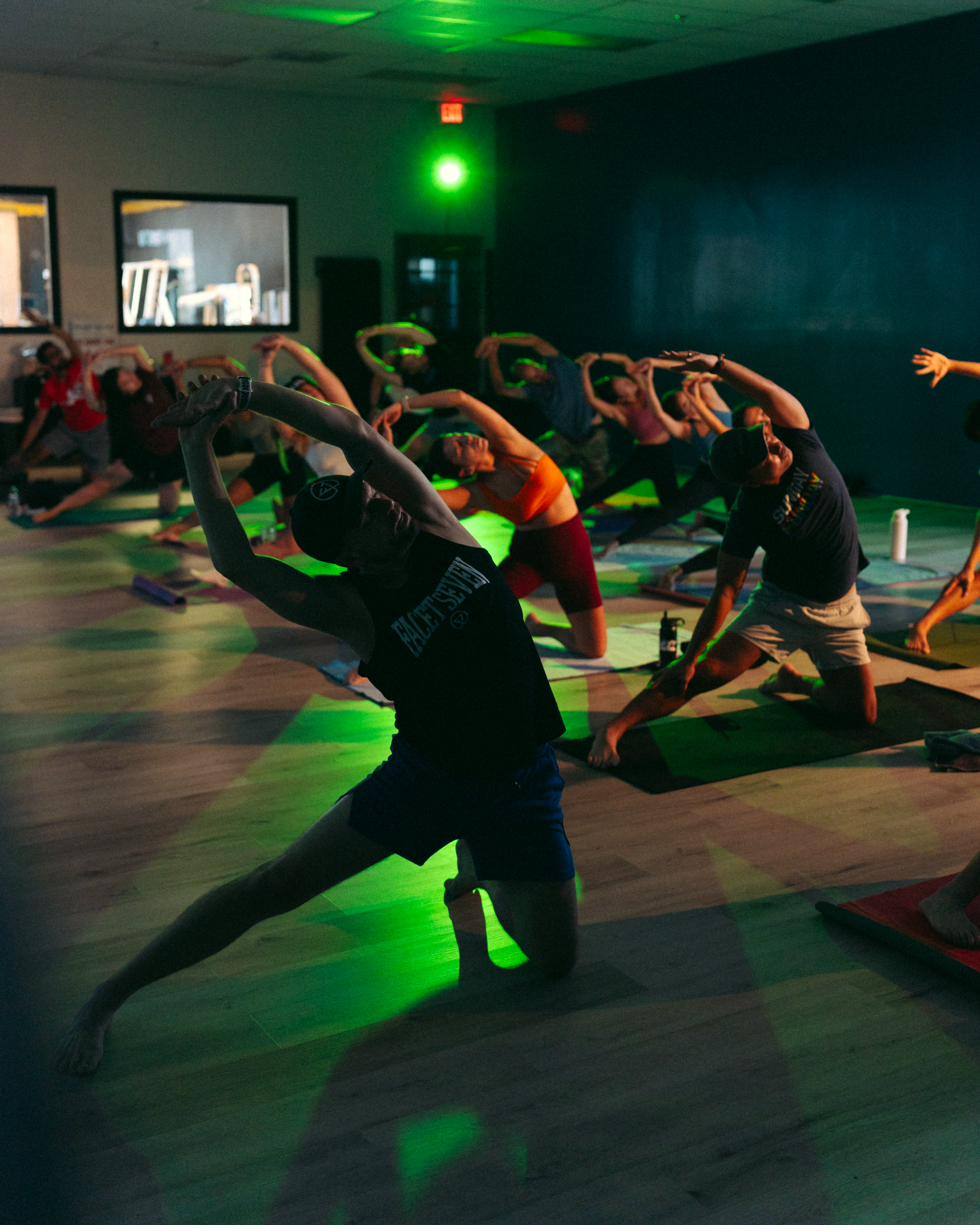
Our flexibility protocol is scored against seven fundamental joint positions - four for the shoulders, three for the hips. The 7 Foundations are the stable end-range shapes the human body is able to create. They're older than us. Babies are born with most of them. We spend our adult lives slowly losing them, one chair, one phone, one steering wheel at a time. The screen measures whether you can still get there. And whether you can control what happens when you do.
3. Endurance Option A - 3-Minute Step Test
This one is a compliment to the Vo2, you can opt to only do the Vo2 or you can do both.
You sit on a plyo box at tibial tuberosity height and record your resting heart rate. Then 3 minutes of UP-UP-DOWN-DOWN at about 24 steps per minute. Sit immediately at 3:00, record peak HR, rest 1 minute, record recovery HR. The spread between those numbers is one of the most honest readouts of cardiovascular efficiency I know. The heart doesn't lie. It either recovers, or it doesn't.
4. Core - Plank Hold
Forearms flat, elbows under shoulders, straight line head to heels. Breathe steady. No sagging, no piking, no knee drop. One warning. Second break, the clock stops. We record max hold time in seconds. Simple, brutal, honest. The plank is one of those ancient tests that requires nothing but your own structure to fail it.
5. Agility - 5-10-5 Shuttle OR 8ft Up-N-Go
Two options, depending on the body in front of us. The 5-10-5 is sprint right 5 yards, sprint left 10 yards, sprint back 5. Plant hard, stay low through the cuts.
The 8ft Up-N-Go is from a seated start. Stand, walk 8 feet, turn, return, sit.
Stopwatch records the time.
*A note on the materials: Core and Agility live on the same protocol page in our booklet, because they run back to back at the assessment. They are not a combined test. Two separate stations. Two separate scores. The page is shared. The scores are not -
6. Endurance Option B - Cooper Treadmill Test
Developed by Dr. Kenneth H. Cooper in 1968 to assess aerobic fitness in military personnel. Sixty years on, it's still one of the most reliable ways to estimate VO2 max. Treadmill at 1% incline to simulate outdoor conditions.
Walk or run as far as you safely can in 12 minutes. We record total distance in miles, then calculate VO2 with a formula:
VO2 Max = (35.97 × miles) - 11.291
Plotted against age and sex, that number gives us your enduranceclassification. Research consistently shows higher aerobic fitness is associated with lower all-cause mortality. So this isn't just a cardio score. It's a longevity number. An old number, with old wisdom in it.
7. Strength - PPSD (Push, Pull, Squat, Hinge)
PPSD is our four-movement strength protocol. Bench press for the push. Strict pull-up for the pull. Back squat for the squat. Deadlift for the hinge. The standard is 3 sets of 5 reps per movement, all three sets completed within 5 minutes per movement. The clock doesn't stop while you rest.
The score isn't raw weight. It's relative to your body. The PPSD formula:
PPSD Score = ((Bench + Pull-Up + Squat + Hinge) ÷ 4) ÷Bodyweight × 100
So a 200-pound athlete who averages 200 pounds across the four movements scores- PPSD @ BW (or 100%) - the top of our scale.
Same with someone who weighs 115lbs and averages a PPSD score of 115lbs.
Push, Pull, Squat, Hinge. Four lifts, one average, scaled to the human you are. That's the full battery. Six stations. Six facets. One
______________
How the score works
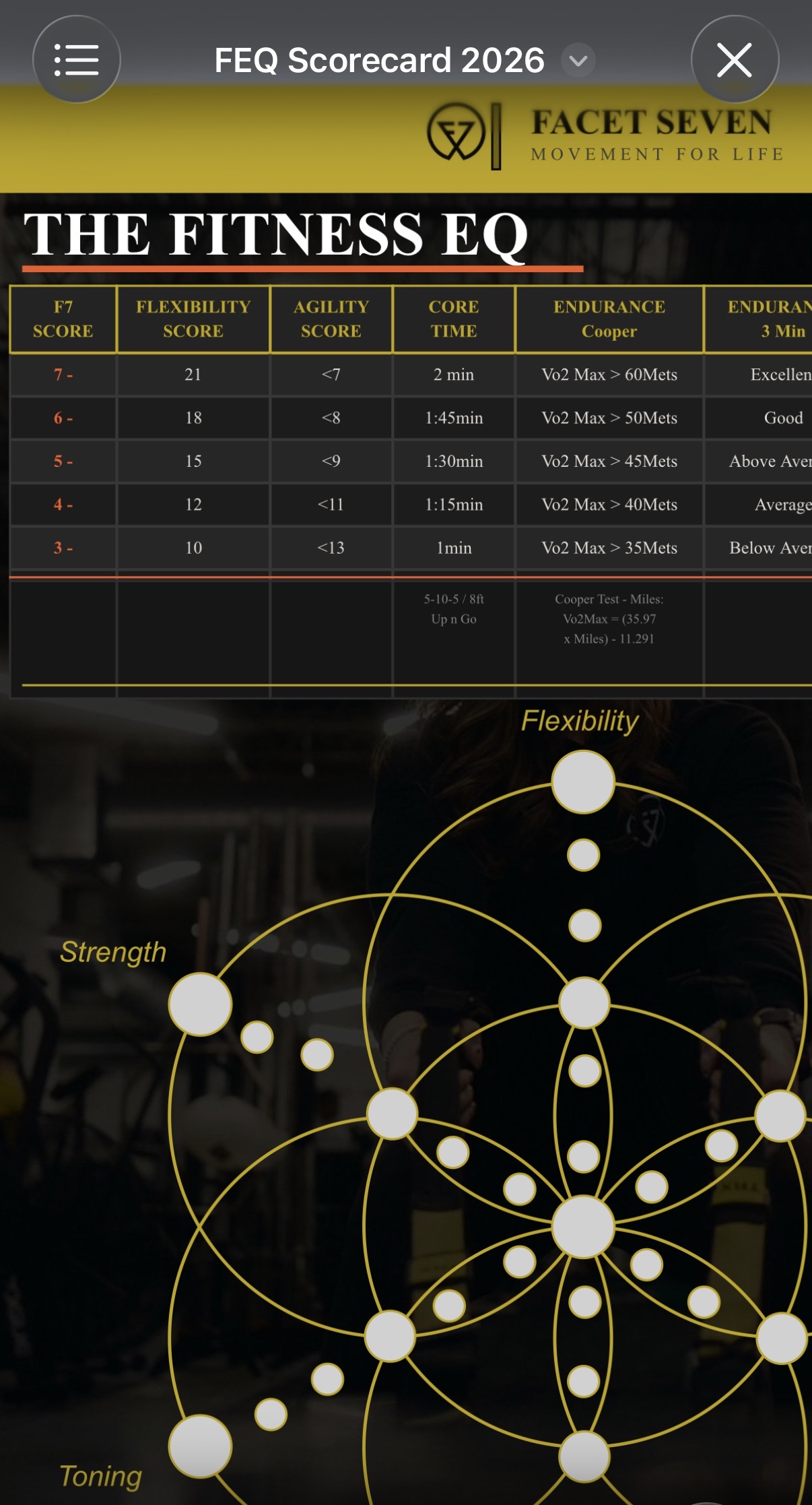
Each facet gets graded on a 1-to-7 scale we call the F7 Score.
The Framework:
F7 Score 7 - Elite. Top of the scale across the facet.
F7 Score 5 - Above average. Trained, capable, room to grow.
F7 Score 3 - Below average. Most untrained adults sit here on at least one facet.
F7 Score 1 - Very poor. Active risk. Investigate immediately.
Each facet has its own thresholds tied to its own protocol. A 7 on flexibility means a clean score of 21 across the 7 Archetypes. A 7 on agility meansunder 7 seconds on the 5-10-5. A 7 on core means a 2-minute plank. A 7 on strength means PPSD at bodyweight.
The scale doesn't grade on a curve. The score is the score. The body doesn't care about effort, intention, or what you used to be able to do. It cares what you can do today. That honesty is the whole point.
Why most people are training a body they can't see
Here's the issue I see almost daily. People train one or two facets very hard and assume the others are coming along for the ride… But they never are. The body has six channels. Most people only listen to one or two.
Some of the most common patterns:
The runner with 30+ miles a week and a flexibility score in the basement.
The engine is loud. The give is gone. The knees are about to send a letter.
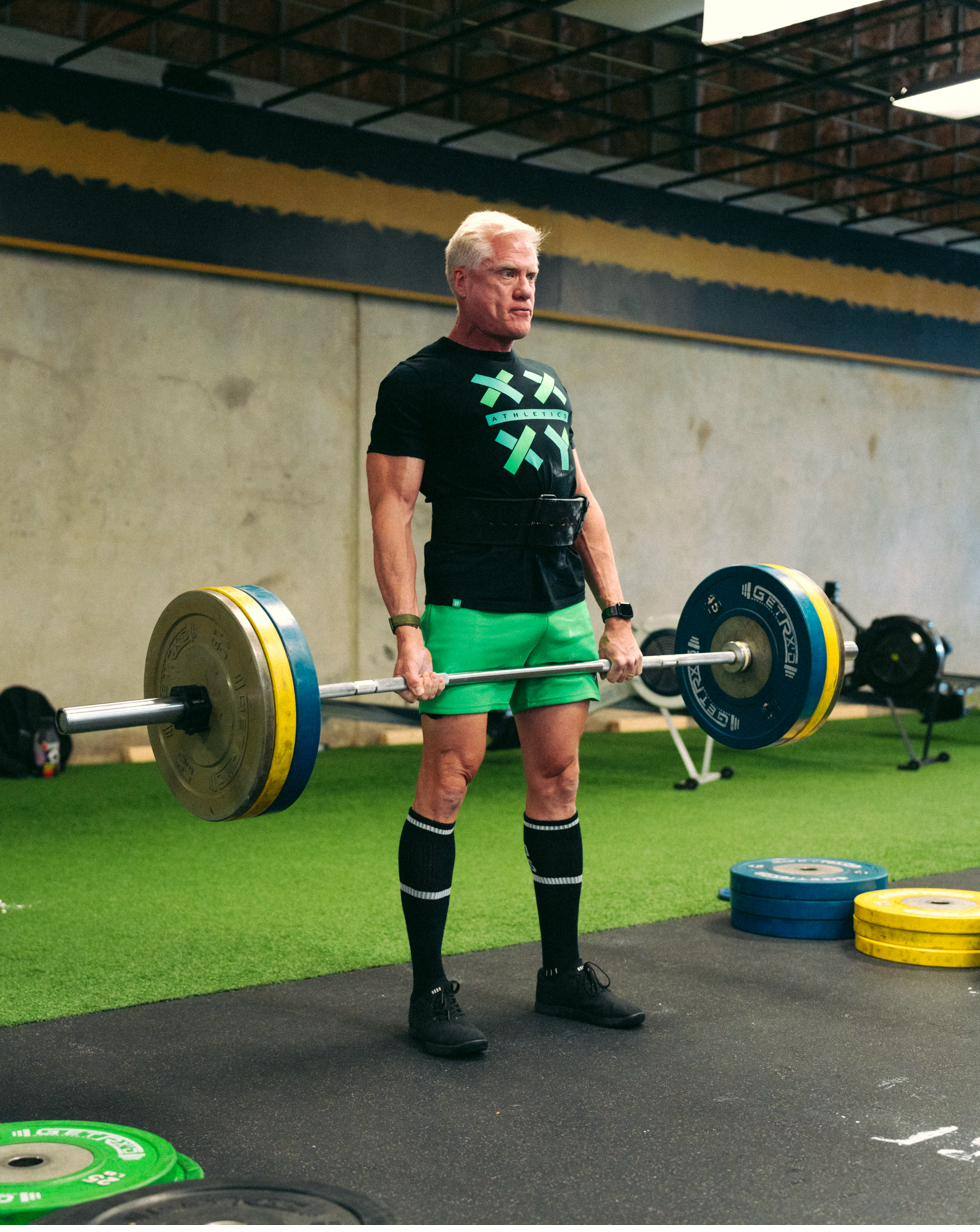
The lifter who deadlifts 400 but can't sit cross-legged on the floor withtheir kid.
Strength dialed in. Range of motion abandoned a decade ago.
The yoga regular who can fold in half but gases out climbing stairs.
Beautiful flexibility. No engine.
The cyclist with an enormous engine and a low back that cant fully extend.
The CrossFitter who's strong, conditioned, decently mobile, and quietly losing toning because they never train at lower intensity for muscle quality.
Every one of these people would tell you they're "in shape." By their favorite metric, they are.
But the body doesn't take votes. The body operates as a system. An untrained facet will eventually drag the whole system down.
Always. It's not a possibility. It's a pattern.
This is why people who feel "fit" still get hurt. Why marathoners blow out knees. Why lifters tweak backs. Why fit 50-year-olds throw out their hipgetting out of a low car seat. The injury isn't bad luck. It's the bill coming due on the facet they never trained.
The body always sends the bill. And it just waits for the worst possible moment.
______________
Three things the FEQ does that nothing else does
The function;
1. It tells you which facet is dragging the rest down.
Almost everyone has one weak facet. Most people have two. The FEQ finds them. We name them. We give them a number. The gap stops being a feeling and becomes information.
2. It gives you a defensible target.
Once we know your six numbers, we know what to move first, and how far. We don't tell you to "get in shape." We tell you something specific. Like: bring flexibility from a 4 to a 7 in 90 days while holding strength steady. That's a program someone can actually run. "Get in shape" isn't.
3. It gives you a baseline to come back to.
This is the one most people underestimate. A single FEQ is useful. Two FEQs, six months apart, is a story. Four FEQs over two years is a record of who you're becoming. The reassessment is where the real value lives. Time is the only honest scoreboard. The FEQ is how you start keeping the receipts.
That's the whole product, in three lines.
______________
The math no one wants to do:
Here's a formula everyone says is common sense when I say it to them:
Vague effort + no measurement = Vague Results
Specific effort + honest measurement = Compounding Results
That's the whole game. The thing that separates the people who keep getting more capable into their 60s and 70s from the people who flatten out at 45 isn't genetics. It isn't time. It's measurement.
The disciplined people who don't measure still flatten out. They just flatten out while working hard. That's actually the hardest version, because they think they're doing the right thing. They're sincere.
They're consistent. They're just blind. The body keeps walking the path it was already walking.
The people who keep climbing know their numbers. They watch the numbers move. When a number stops, they change something. When one drops, they investigate. They've stopped guessing. The fog has lifted, and they can see the trail.
That's something I notice with the longest-tenured members at Facet Seven.
After a few cycles of measuring, retesting, measuring again, something shifts in them. They stop fighting their body and start listening to it.
That's not philosophy. That's just what happens when you stop guessing.
______________
The FEQ for the everyday person (35 to 55, healthy, busy)
This is who I'm writing this blog for, more than anyone. The Houstonian who's been "into fitness" for years. Lifts on Mondays and Wednesdays.
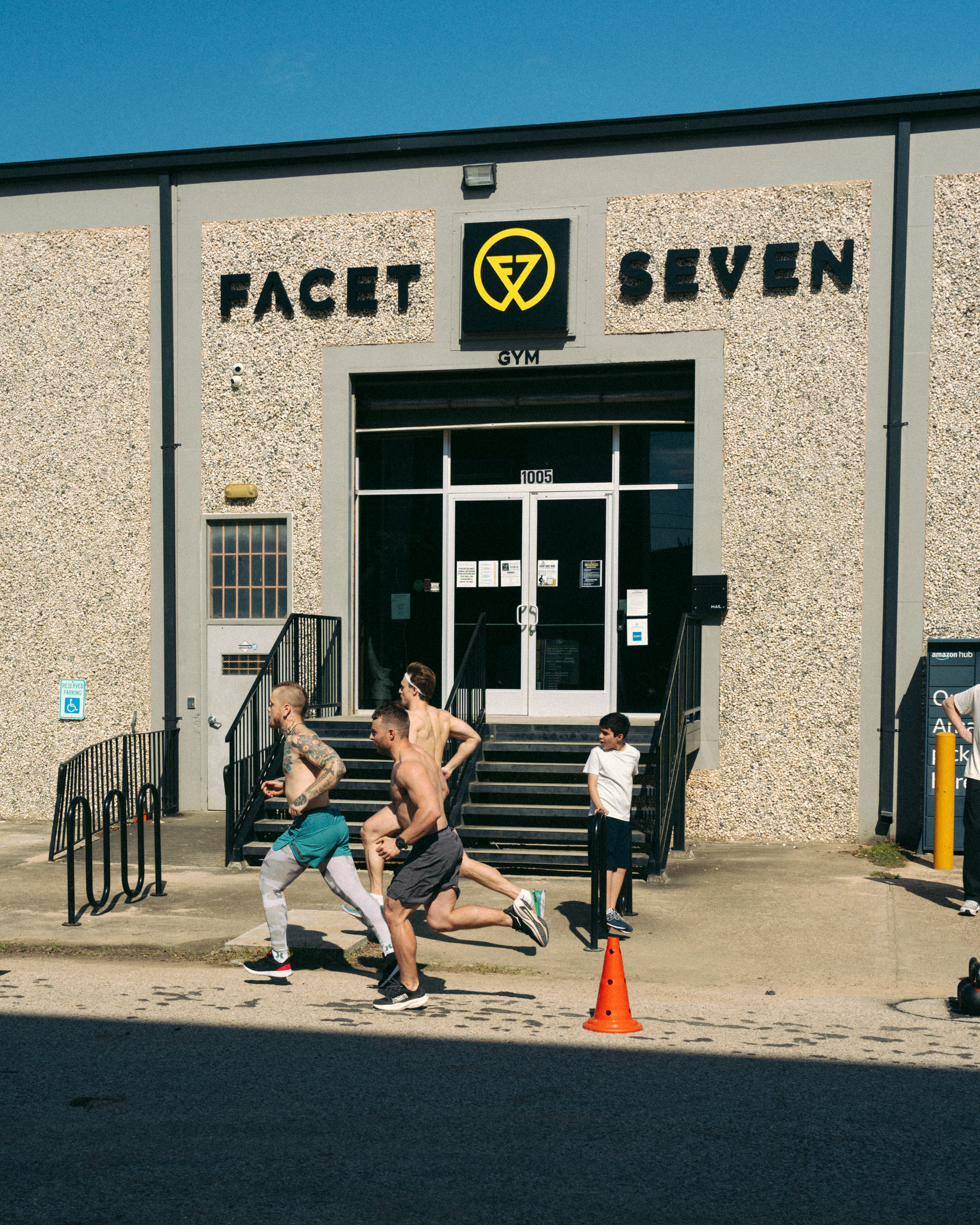
Runs Memorial Park on Saturdays. Does a yoga class when their wife asks. Drinks the right amount of water most days.
You're fit. You're not new. But there's a feeling you can't quite name. A sense that what you're doing might not be enough. That something is shifting underneath you. You're not wrong. The body is shifting. It's been shifting all along.
The FEQ just makes it visible.
Here's what the FEQ does for you:
A. It shows you the whole picture. Most home routines are lopsided. Most are heavy on whatever you liked in your 20s. The FEQ shows you all six facets at once, in the same picture, for the first time.
B. It catches things early. A genuinely low score in one facet is sometimes the first signal of an old injury that never finished healing.
Or a movement pattern that's quietly degrading. We find those before they become a tweaked back at a wedding.
C. It replaces a hum with a picture. Most people in this age range are carrying around a low hum of fitness anxiety they don't even know they have.
The FEQ shuts that hum off, because vague is replaced by clear.
D. It makes the next 90 days obvious. When you know which facet isdragging the rest, you know what to train. You stop wandering through workout decisions. You execute against the gap.
E. It buys you the 78-year-old version of yourself.
I lost my grandfather in 2010. A lot of why this gym exists in the first place is the conviction that the slow, preventable decline I watched him go through doesn't have to be the default ending.
My mission, the one I've held since then, is to improve the quality of longevity for every person I meet.
The quality of longevity is designed by training all six facets, not your favorite two.
Not because I say so. Because nature already decided.
If you're in this group, the FEQ is the most leveraged hour or so you'll spend on your fitness this year. Maybe this decade.
______________
The FEQ for the athlete
Different conversation, same tool.
If you're a competitive athlete, or a former one who still trains like one, the FEQ does something different for you. It exposes the facet that's capping the one you're proud of. Because in athletics, your ceiling is set by your weakest facet, not your strongest. That's not opinion. That's mechanics. That's as constant as gravity.
That's the rule the body has always played by, whether you knew the rule or not.
Some patterns I see:
A. The plateaued athlete. You used to PR every cycle. Now you don't. Youassume it's age. It usually isn't. It's usually a quiet facet finally pulling enough weight to stall the loud one. The FEQ shows you which one.
B. The injury-prone athlete. You keep getting hurt in the same area. The injury isn't bad luck. It's a facet imbalance expressing itself under load. The FEQ shows the imbalance before it shows up on an MRI.
C. The pre-event athlete. Reassess 8 to 12 weeks out from a race, a meet, a tournament. You'll know exactly what to sharpen. You'll taper from data instead of nerves.
The athlete-specific math:
Stronger + more flexible + better conditioned = more force at lower cost.
Force is what wins races, fights, lifts, games. Cost is what catches up to you in the back half of a season or a career. The FEQ raises the first and lowers the second at the same time. The great athletes I've coached eventually figure this out. Most of them figure it out the hard way. The FEQ just shortens the lesson.
______________
The FEQ for the coach or trainer
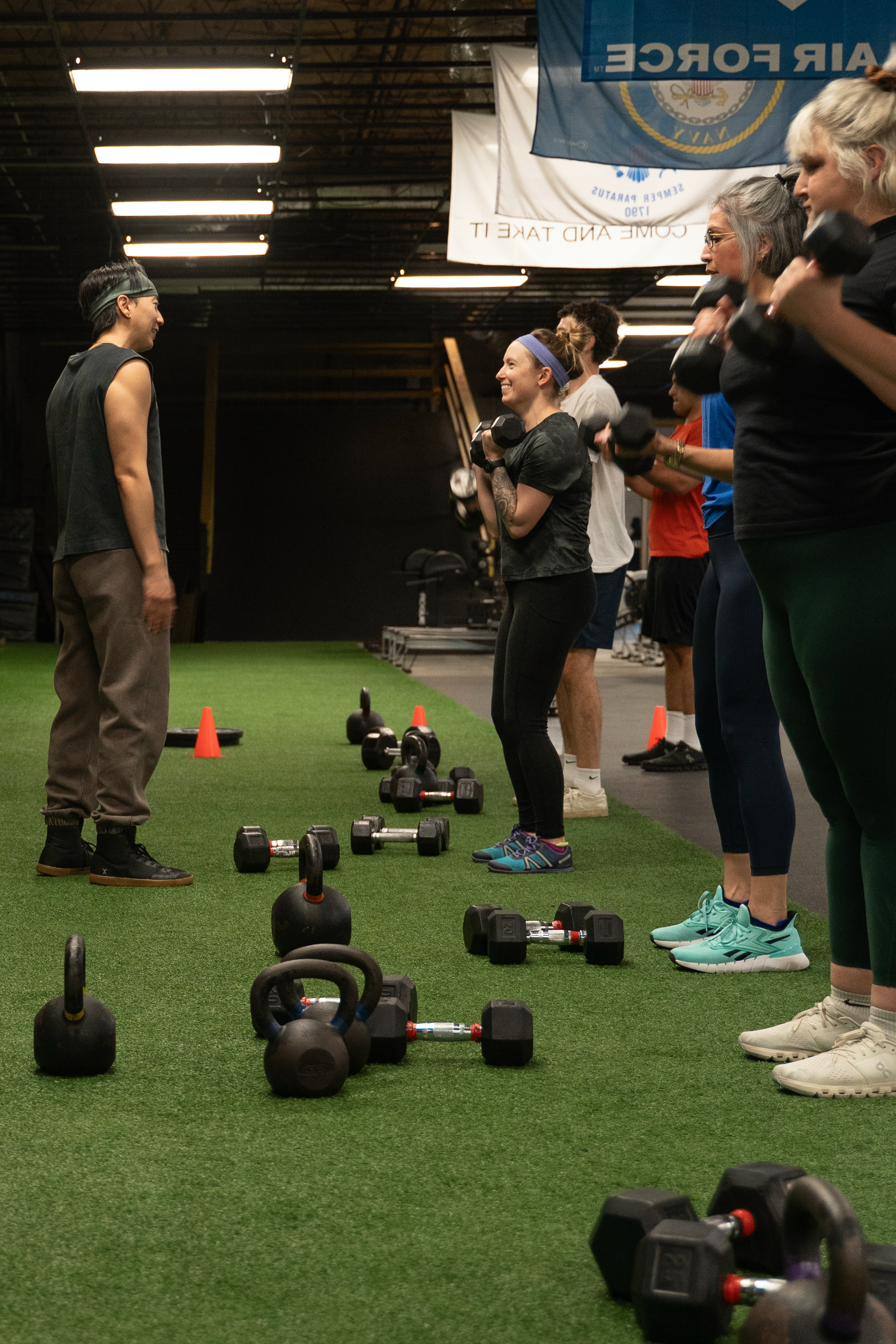
Now to the coaches reading this. Some of you are on my staff. Some are at other gyms. Some train clients in garages or online. I've been coaching since 2008. I've made every mistake on this list. That's the only reason I get to write it.
Coaches need three things from an assessment:
A. Programming clarity.
You can't write an honest program without an honest baseline.
The FEQ gives you six data points instead of a vibe. Once you can see the client's full picture, the program writes itself.
B. Client retention. Clients don't quit because they aren't progressing. They quit because they can't see they're progressing. A score that moves from a 4 to a 6 over a quarter is a story your client tells at dinner. Vague feelings of "getting stronger I think" are not. The reassessment is the retention engine.
C. A different professional identity. When you're the coach who measures, you're not the coach who counts reps. You're the coach who is measurably moving the human forward. That's a different conversation, a different relationship, and frankly a different price point.
If you're a coach without an assessment system, build one or borrow one. I'm not precious about whose framework you use. What matters is that you stop guessing. We're happy to walk other coaches through the FEQ. Email me.
The principle matters more than the proprietary version. The truth was already there. We just gave it a clipboard.
How often to retest
This is where most people get it wrong. They take an assessment once, get a number, and never come back to it. That number is now a paperweight. Thebody kept moving. The score didn't.
The reassessment cadence we recommend:
A. Every 90 days for the athlete in active training.
B. Every 6 months for the everyday adult who wants steady progress without making fitness a second job.
C. At minimum once a year for anyone who cares about their long-term physical life.
A year is the floor. Less than a year, you're collecting a stat. The whole point is the comparison. Watching the numbers move with the seasons. Watching yourself become someone.
Three quick rules I follow on reassessment day:
1. If a number moved up, hold the program in that facet for one more cycle, then look again.
2. If a number stalled, change something. Don't wait two more cycles to "see if it kicks in."
3. If a number dropped, investigate immediately. Drops are signal. The body is telling you something. Don't make it say it twice.
That's the whole reassessment protocol, in three lines.
What separates the FEQ from a regular fitness assessment
A few things, since I get this question a lot.
A. It's six facets, not one or two. Most assessments measure strength and cardio. We measure six. The picture is full.
B. It can be personally OR coach-administered. A watch can't replace eyes on the body, so we always recommend having a spotter and a close training partner for all the tests. If you hire a coach, it’s best as we see the compensations the data misses.
C. It's tied to a real coaching system. The score isn't an end. The score is the front door to the program. The protocols connect to actual training, not a generic plan.
D. It's repeatable. Same protocols every time. Same scoring every time. So the comparison across reassessments is real, not ballpark.
E. It was built for people, not just athletes. Athletes use it, and benefit. But the FEQ was designed first for the human being who wants to live a long, capable, full physical life. Everything else is downstream of that.
Two formulas before I close
These are the two I keep coming back to with members.
Formula 1: The mobility formula
“Strength through Length” - maintain strength and control through the length of the muscle. The Holy Grail.
Drop any one of those to zero and the equation collapses.
Keep all six honest, even at modest levels, and the body keeps showing up. Year after year. Thebody shows up for the people who show up for it.
Formula 2: The LongevityME formula
Movement + Nutrition = Vitality or quality of longevity
Quality of longevity is the whole game. Not how long you live. How well you live for while we’re here. Whether you can pick up your grandkid at 75. Hike with your dog at 78. Throw a bag in the overhead bin at 82 without thinking about it.
You don't get there by accident. You get there because somewhere along the way, somebody helped you measure what mattered. Then helped you train it.
That's all the FEQ is.
Come find your number.
If any of this lands, here's what I'd ask:
A. Just test yourself. You don't have to commit to anything after, but what you find may guide you.
Click here to test yourself.
B. Take the score & program for it. Or take the scorecard to your trainer, your doctor, your coach. Let them see the picture. Let them work with real data instead of guessing.
C. Come back in 6 months. Run it again. Watch the numbers move.
That's the whole ask. Stop training in the dark.The body already knows. Nature has been keeping the score this whole time.
The only question is when you're ready to see it.
Movement for Life.
Cheers,
Layn Chess
Founder & Training Director
Facet Seven Fitness