Black toenails.
Snot crust.
Part of our running series. Run Better in 2027 covered training less and recovering more. Yoga for Runners covered owning your range. Salt and Runners covered the white stuff on your socks. This one covers the two things nobody puts in the finish line photo.
My middle toenails just started to bruise.
Both of them. The third toe on each foot. I've lost toenails before, so I know where this road goes if I ignore it.
A black toenail isn't a badge. It's a message from your shoe. So here's the research.
Of 719 trail runners reported a toenail injury in one year. It was the most common injury in the study.6
Of marathon runners report toenail injuries on race day, depending on the study.9
Of 144 skiers had a runny nose from cold air. For 96% of them, the drip was the main symptom.1
Of people surveyed got a runny nose from outdoor exercise. Allergies or not.10
A black toenail is a bruise under glass.
The medical name is subungual hematoma. Subungual means under the nail. Hematoma means pooled blood. The black you see is blood trapped between the nail and the bed it sits on.5
It's rarely one hit. It's the same small tap, thousands of times, like dropping a pebble on your toe once a stride for two hours. Over enough miles, the tiny vessels under the nail give way.5 When the nail loses its blood supply, it often lets go weeks or months later.
Why it happens
The shoe is too short.
The toe hits the front of the shoe every stride. Podiatrists see this most.4
The shoe is too loose.
A foot that slides inside the shoe drives the toes into the front wall, worst on downhills.11
Your foot changes mid-run.
Over 10 km, runners' arches dropped, the ball of the foot narrowed, and the foot heated up. That shifted the foot forward in the shoe and closed the gap at the toes.8
The longest toe takes the hit.
It's usually the big toe or the second toe, whichever reaches the front first.9 Toe shape, a bent toe, or heavy pronation can move the hit to a different toe.4
Downhills multiply it.
Gravity pulls the foot forward on every descent.4 It's one more reason the trail asks more of your feet than the road does, the same lesson from Run Better in 2027.
Toe meets shoe. Repeat thousands of times. The nail keeps the score.
Three things to do right now.
All three come straight from the research.
Cut straight across.
Level with the end of the toe, every week or two, and a day or two before a long run. A long nail is the first thing to hit the shoe.2
A thumb's width up front.
Stand in the shoe and leave about a thumb's width past your longest toe. Fit the toe, not the number on the box.27
Lock the heel. Free the toes.
Snug through the heel and midfoot so the foot can't slide forward. Easy over the toes so they can spread. Heel-lock lacing uses the top eyelet to do this.7
Trim. Fit. Tighten just right.
- I'm trimming my nails straight across, so the edge isn't the first thing to meet the shoe.
- My new shoes fit right, with room past the toes for the swelling that comes on long runs.
- I lace them just right. Not too tight, not too loose. Tight enough to hold the heel, loose enough to let the toes breathe.
See a podiatrist or doctor if the toe throbs with pressure, shows signs of infection, or turns dark without any injury you can name. A dark streak with no trauma behind it needs a professional look, not a guess.4
Trim the nail. Fit the longest toe. Lock the heel.
Chevron Houston, January 2012.
My first half marathon was the Chevron Houston Half Marathon, January 15, 2012. At the finish line I saw runner after runner with dried snot streaked across their cheeks. Proud faces. Crusty faces.
It was about 40 degrees that morning. The day before, the US Olympic Marathon Trials ran through the same downtown streets with a forecast start of 41.12
So I wanted to know. Why does the nose turn on like a faucet the minute the run starts?
Cold air makes the nose run.
Your nose is a humidifier with a heater. Every breath gets warmed and wetted before it reaches your lungs. Cold, dry air pulls heat and water out of the lining of the nose, and the nose answers by making more fluid.1
It's a reflex. Nerves in the nose sense the cold and signal the glands to pour out fluid. When researchers blocked that nerve signal with a nasal spray, cold-air dripping dropped by 73%.3 In people sensitive to cold, cold dry air also releases histamine and other chemicals that add to the flow.13
Cardio makes it run too.
Here's the twist. Exercise actually opens the nose. Your nervous system tightens the blood vessels in the nose to clear the airway. Nasal resistance drops within 30 seconds and bottoms out around 5 minutes in.14
But you're moving a lot more air. More breaths mean more air for the nose to warm and wet, and more water pulled from the lining. The nose keeps up by making more fluid, and the open airway gives it a clear path out.
I snot as much on the bike as I do on a run, indoors and outdoors. Outdoors, speed adds wind, so more cold air rushes across your face. Indoors, the cold is gone, yet it still happens. A study of athletes found exercise triggers a runny nose both indoors and outdoors, with or without allergies, and the drip is the main symptom.10
More air in. More water out. The nose makes more to keep up.
Same crust as last week.
Snot is about 95% water. The rest is mucin, proteins, and salts.15 When the water dries off your cheek, the rest stays behind.
It's the same story as the white crust on your socks in Salt and Runners, and the same story as every grain of salt on Earth. The water leaves. The salt stays.
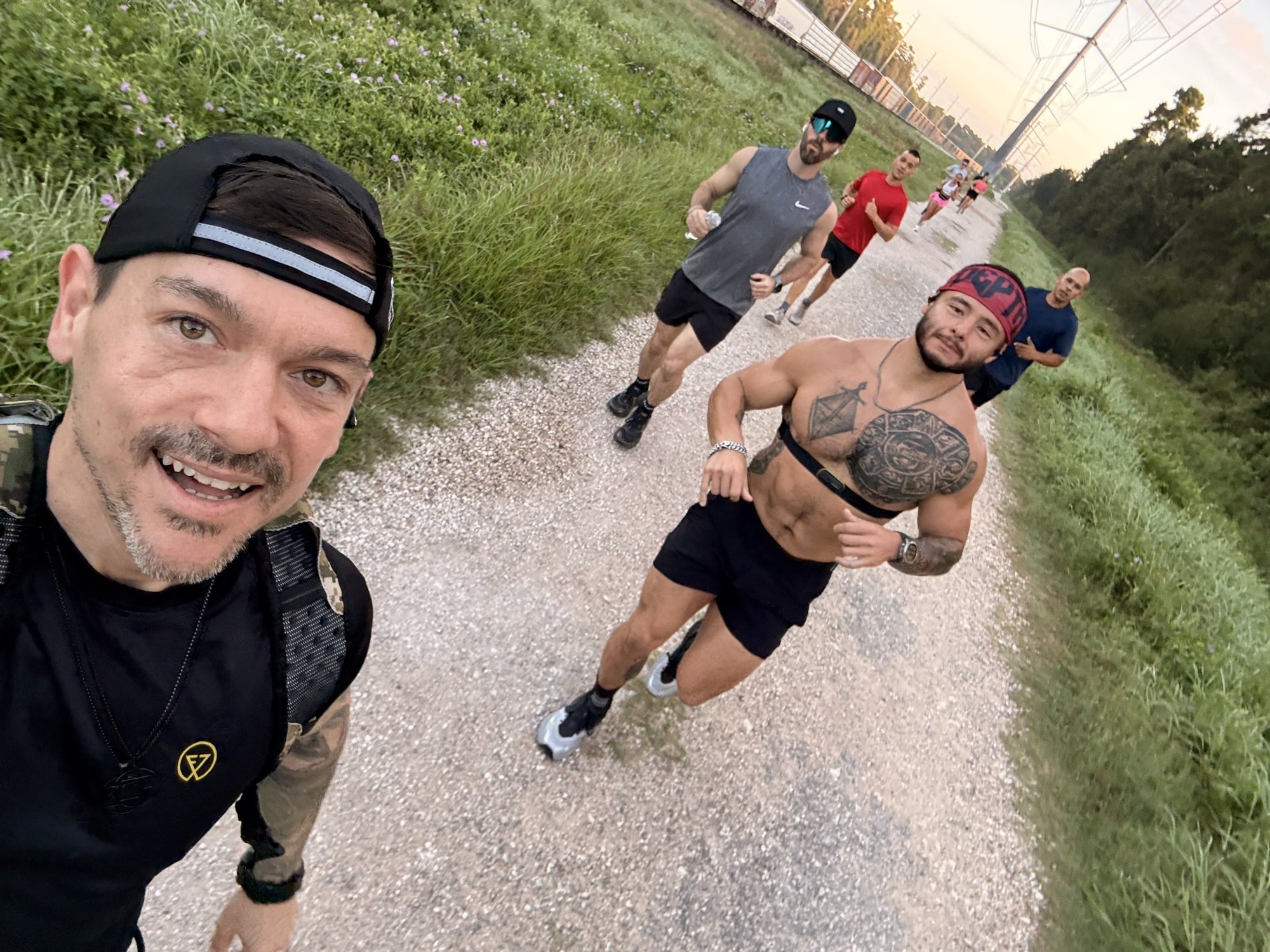
Does it matter?
Mostly, no. The nose isn't what limits your running. As effort climbs, most people shift to breathing through the mouth and nose together.16
Usually cosmetic.
For some it's more than that. In one survey, 40% said a runny nose during indoor exercise hurt their performance.10
Listen to the rest of the body.
Sneezing, itchy eyes, chest tightness, or wheezing with the drip can point to allergies or exercise-induced asthma. That's a doctor visit, not a tissue.17
Mind the runner behind you.
A computer simulation found runners and cyclists leave a trail of breath droplets behind them as they move.18 A snot rocket adds a lot more than breath. Check over your shoulder, step to the side of the course, and aim low. Or tuck a tissue in your pocket. Your running partners will thank you.
Look back. Step aside. Aim low.
Runner questions, answered
Why do runners get black toenails?
The toe hits the front of the shoe over and over, and blood pools under the nail. Shoes that are too short or too loose, swelling feet, and downhills make it worse.
How do I stop losing toenails from running?
Trim nails straight across, leave about a thumb's width past your longest toe, and lace to lock the heel without squeezing the toes.
Why does my nose run when I run?
Cold, dry air triggers a nerve reflex that makes the nose produce fluid. Exercise adds more airflow for the nose to warm and wet, so it makes even more.
Is a runny nose during exercise a problem?
Usually not. If it comes with sneezing, itchy eyes, wheezing, or chest tightness, see a doctor to rule out allergies or exercise-induced asthma.
The point
Your body leaves notes. A black nail says the shoe and the foot disagree. A crusty cheek says the nose did its job in the cold.
Trim, fit, and lace for the nails. Look back before the snot rocket. Then keep running.
Movement is half of the formula. The other half is what you feed it.
Nutrition for Longevity
Learn how to fuel training, recovery, and a long life. The course is built by Facet Seven on the same Movement + Nutrition formula behind LongevityME, taught by La Professora.
Join the run crew
Rather have a plan and a crew? Join our WhatsApp group and train for your next long race with people who will meet you at the start line.
Reading on your phone? Tap the button. On a laptop? Scan the code.
Know a runner with a black toenail and a crusty cheek?
Send this their way.

Movement for Life.
Cheers,
Layn Chess
Founder & Training Director
Facet Seven Fitness
- Cold-induced rhinitis in skiers: clinical aspects and treatment with ipratropium bromide nasal spray. Am J Rhinol, 2001.
- Achilles Foot and Ankle Center. Black toenails from running: causes, treatment, prevention.
- Østberg B, Winther B, Mygind N. Cold air-induced rhinorrhea and high-dose ipratropium. Arch Otolaryngol Head Neck Surg, 1987.
- Live Science. What's runner's toe? Interview with sports podiatrist Ayne Furman.
- McGill Office for Science and Society. Runner's toenail.
- Matos S, et al. Running-related injuries in Portuguese trail runners: a retrospective cohort study. J Sports Med Phys Fitness, 2021.
- Balance Foot and Ankle. Black toenail from running.
- Influence of changes in foot morphology and temperature on bruised toenail injury risk during running. Sci Rep, 2024.
- Mailler-Savage EA, Adams BB. Skin manifestations of running. J Am Acad Dermatol, 2006. Figures via Sci Rep, 2024. See also Mailler EA, Adams BB. The wear and tear of 26.2. Br J Sports Med, 2004.
- Silvers WS, et al. Exercise-induced rhinitis in athletes. Ann Allergy Asthma Immunol, 2012. Via HealthDay.
- Runner's Blueprint. How to prevent black toenails from running.
- Stride Nation. Olympic Trials Marathon 2012: weather forecast.
- Togias AG, et al. Nasal challenge with cold, dry air results in release of inflammatory mediators. J Clin Invest, 1985.
- Nasal reflexes: implications for exercise, breathing, and sex. PMC review.
- Mental Floss. Why are there boogers in my nose?
- Frontiers in Physiology. Nasal decongestion during oronasal breathing in incremental maximal exercise, 2025.
- European Medical Journal. Exercise and rhinitis in athletes.
- Blocken B, et al. Towards aerodynamically equivalent COVID-19 1.5 m social distancing for walking and running. Preprint, 2020. Via The Philadelphia Inquirer.
This post is education, not medical advice.
© CMV, LP. Facet Seven Fitness™ is a brand of CMV, LP