Speed.
Threshold.
Base.
Part of our running series. Run Better in 2027 covered the three energy systems. Yoga for Runners covered owning your range. Salt and Runners covered fueling. Black Toenails and Snot Crust covered the wear and tear. This one covers the engine, and how to build it.
I had a new client this week.
He's a runner in his 40s. He wants to keep running, feel good, and live a long, healthy life with his family. During his FitnessEQ, he asked me why we test VO2.
That's when I realized how many people don't know what VO2 max is. Why it matters for longevity. How it helps you run faster for longer. Or how to train it.
So this week, we cover all four.
VO2 max is the size of your engine.
It's the most oxygen your body can take in and use in a minute, measured in milliliters per kilogram of body weight. Lungs bring the air in, the heart pumps it out, and the muscles burn it. The bigger that number, the more work you can do before you run out of breath.
We test it with a 12-minute run. Dr. Kenneth Cooper built the test in 1968, the same year his book gave the world the word "aerobics."8 Two years later he opened the Cooper Clinic in Dallas. Cover more ground in 12 minutes, and your estimated VO2 max goes up.
Breath + Fuel = Movement
The number that predicts your future.
How long you live, and how well.
Cardiorespiratory fitness predicted early death better than any traditional risk factor in a study of 750,302 adults followed for about 10 years.9 Not cholesterol. Not blood pressure. The engine.
Higher risk of death for the least fit compared to the most fit, across 750,302 adults ages 30 to 95.9
Lower risk of death for every 1 MET of fitness you add. One MET is 3.5 ml/kg/min of VO2.9
Longer life for the fittest men in midlife compared to the least fit, followed for 46 years.10
Lower risk of death for elite fitness compared to the lowest fitness, in 122,007 adults.7
Being unfit is a risk factor.
Cleveland Clinic tested 122,007 adults on a treadmill. Low fitness carried a risk of death comparable to, or greater than, smoking, diabetes, and heart disease. The fittest group lived longest, and the benefit kept climbing at the top. No ceiling.7
The first big proof came from right up I-45. In 1989, researchers at the Cooper Institute in Dallas showed that fitness predicts lifespan in healthy men and women. The biggest drop in risk came from simply moving out of the least-fit group.11 You don't have to be elite to win. You have to stop being last.
Alive 20 years later
Survival at 20 years by fitness level, 750,302 adults.9
The engine shrinks unless you feed it.
VO2 max drops with age. About 3 to 6% per decade in your 20s and 30s, speeding up to more than 20% per decade in your 70s.12 After 30, fitness falls about 1% a year, and fit people lose it at roughly half that rate.9
Think of it like a savings account for your 80s. Everyone starts making withdrawals after 30. The deposits you make in your 40s decide what's left when you need it to climb stairs, carry groceries, and get up off the floor with your grandkids.
It's not only your heart.
A 2024 review pooled 199 studies and 20.9 million observations. Low fitness was a key risk factor for early death, heart disease, stroke, high blood pressure, dementia, and depression.13 Same engine. More than one payoff.
Five more years with your family.
In Copenhagen, 5,107 men ages 40 to 59 had their fitness measured, then were followed for 46 years. The fittest lived 4.9 years longer than the least fit.10
Build the engine in your 40s. Run on it in your 80s.
The three phases
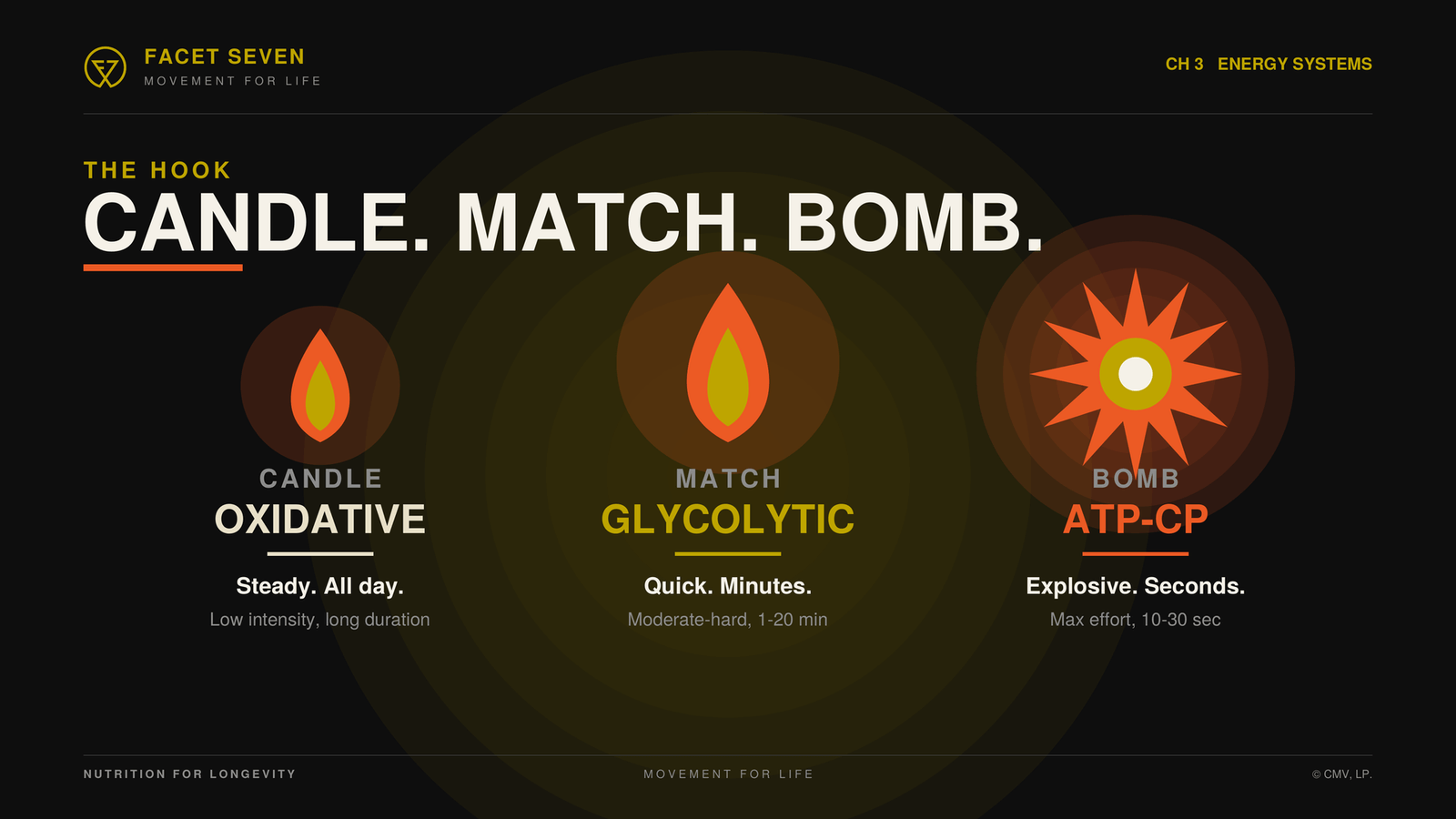
In Run Better in 2027 we covered the three energy systems. In Chapter 3 of Nutrition for Longevity, La Professora calls them the candle, the match, and the bomb. Each phase of run training leans on a different one.
Of elite endurance training is done at low intensity. The other 20% is the hard work.1
VO2 max gain in 8 weeks from intervals at 90 to 95% of max heart rate. Long slow running and threshold running at the same total effort did not raise it.2
Of the energy in a 1,500 m race comes from the aerobic system. Even fast running is mostly oxygen.3
Of VO2 max is the range elite marathoners hold for 26.2 miles.4
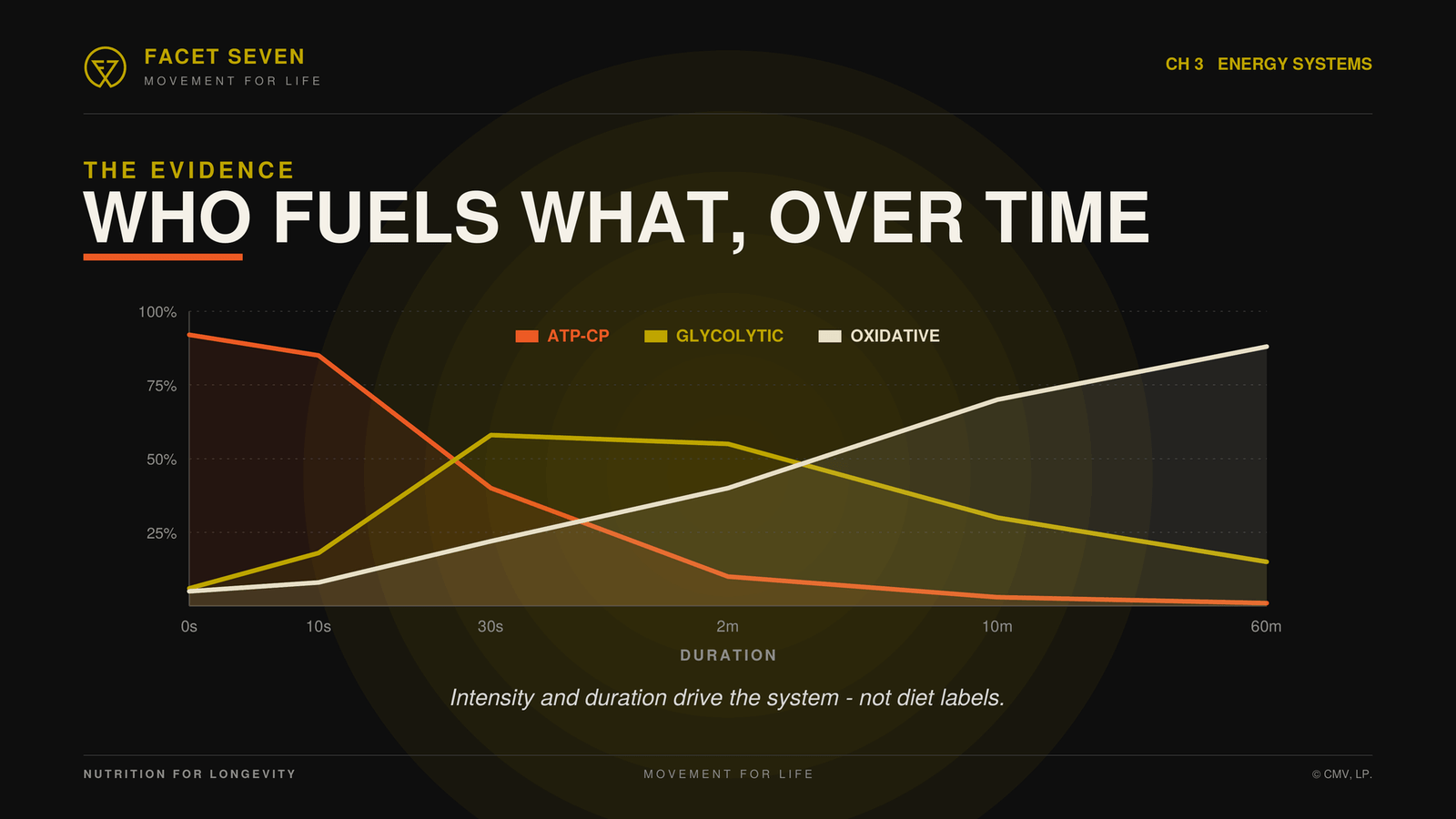
Time and intensity decide which system leads. The first seconds belong to ATP-CP. Glycolytic takes over for hard minutes. Past 10 minutes, oxidative carries most of the load.
Speed
The bomb. Raises the ceiling.
Short, hard repeats in Zone 4 and 5, about 1 to 2 minutes at a time, with easy running between. Speed work grows your VO2 max. In one study, both 15-second and 4-minute intervals at 90 to 95% of max heart rate raised VO2 max, while long slow running and threshold running at 85% did not. Intensity drove the gain, and it tracked with a stronger heart that pumped more blood per beat.2
Threshold
The match. Closes the gap.
Longer repeats in Zone 3 and 4. Threshold is the fastest pace you can hold before lactate builds faster than your body clears it. A higher threshold lets you run closer to your ceiling for longer.5
Base
The candle. Builds the engine.
Long, easy running in Zone 2 and 3. Base is where the body builds more mitochondria, the power plants in the muscle. More mitochondria means you burn more fat and less stored sugar at the same pace, and make less lactate doing it.6
All three systems are always on. Each phase just turns one of them up.
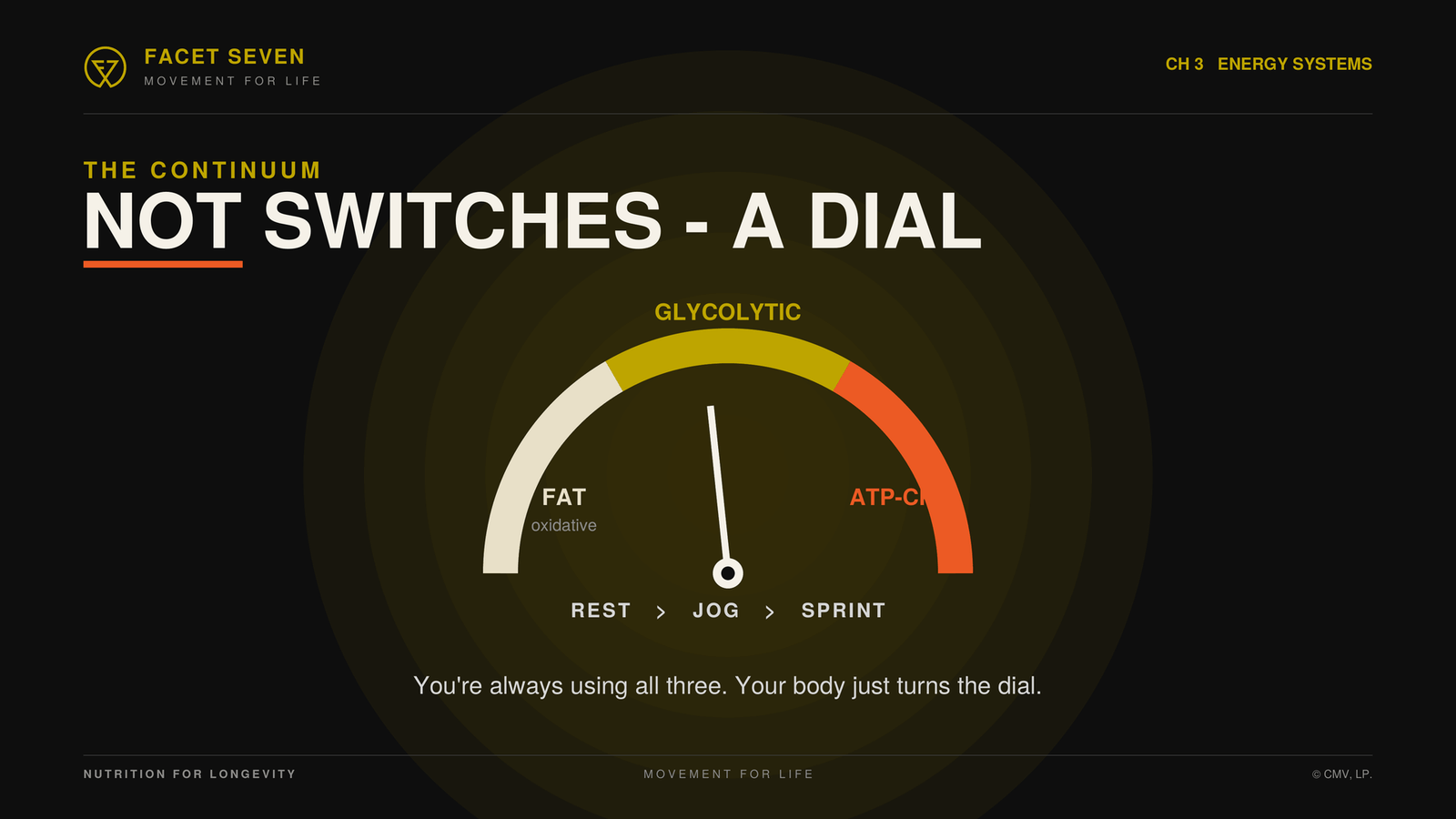
Speed builds the ceiling. Threshold closes the gap. Base builds the engine under both.
One engine, three phases.
VO2 max runs through all of them.
Three things decide how fast you can run a long way: how big the engine is, how much of it you can use for hours, and how little oxygen each stride costs.45
Grow the engine. Use more of it. Spend less oxygen per stride.
Where a bigger engine pays off
The long run is where you feel it. A bigger VO2 max makes the same pace a smaller share of your max. That's an easier effort, more fat burning, and glycogen that lasts longer. Or you hold the same share and run faster.
Raise VO2 max from 50 to 54.
That's an 8% gain, in the range the interval study saw in 8 weeks.2 Marathon pace at 75% of VO2 max:
- Hold the old pace and it costs 69% of your engine instead of 75%. Easier miles, more fat, more glycogen left at mile 20.
- Hold 75% and you have 8% more oxygen per minute to spend. With the same running economy, that's roughly 8% more speed. A 4:00 marathon becomes about 3:42.
Illustration only. Real gains depend on your starting point, your threshold, and your economy.
A bigger engine saves fuel. The fuel you carry still matters. Salt and Runners covers what to replace on the long ones.
Week 6, all three phases.
Plus three strength days.
Here's Week 6 of our Runners High Marathon Strength program. Speed on Wednesday, threshold on Friday, base on Sunday, and strength on the days between, because strength breeds endurance. Monday is a good day for the hips and hamstrings work in Yoga for Runners.
The full week, with every interval, lift, and core movement laid out day by day, is free.
Download Week 6 (PDF) ↓Run Bandera with us.
January 10, 2027. Hill Country State Natural Area.
31 miles of rocks, sotol, and Hill Country grades. The Facet Seven Fitness Hippies are running the Bandera 50K, and there's room on the team.
The Bandera 50K Ramp Program.
Speed, threshold, and base runs every week, three strength days, and a taper that gets you to the start line fresh. The same three phases from this post, built for the trail.
Sunday, January 10.
Hosted by Tejas Trails in Bandera, Texas. The race fee is $160 through December 1, then it goes up.
Pick the 50K, then join the Facet Seven Fitness Hippies team at checkout. Race details at tejastrails.com/bandera. Trail miles are hard on toes, so read Black Toenails and Snot Crust before your first long one.
Runner questions, answered
What are the three phases of run training?
Speed, threshold, and base. Speed raises VO2 max, threshold raises the pace you can hold before fading, and base builds the aerobic engine with long, easy miles.
Why does VO2 max matter for longevity?
Higher cardiorespiratory fitness is linked to a lower risk of early death. In 750,302 adults, the least fit had about four times the risk of the most fit.
Does VO2 max matter for a marathon?
Yes. Marathon pace is a share of your VO2 max. A bigger VO2 max makes the same pace easier, or lets you hold the same effort at a faster pace.
How much of my running should be easy?
Elite endurance athletes do about 80% of their training at low intensity and about 20% hard.
The point
My client asked why we test VO2. Here's the short answer. It's the size of your engine, and the engine decides how far you can go, in a race and in a life.
Grow it with speed. Learn to use more of it with threshold. Make it cheap to run with base. Then keep showing up, in your 40s and every decade after.
Movement is half of the formula. The other half is what you feed it.
Nutrition for Longevity
The candle, the match, and the bomb come from Chapter 3. Learn how to fuel training, recovery, and a long life. Built by Facet Seven on the same Movement + Nutrition formula behind LongevityME, taught by La Professora.
Join the run crew
Rather have a plan and a crew? Join our WhatsApp group and train for your next long race with people who will meet you at the start line.
Reading on your phone? Tap the button. On a laptop? Scan the code.
Know a runner who wants to keep running for life?
Send this their way.

Movement for Life.
Cheers,
Layn Chess
Founder & Training Director
Facet Seven Fitness
- Stöggl TL, Sperlich B. The training intensity distribution among well-trained and elite endurance athletes. Front Physiol, 2015.
- Helgerud J, et al. Aerobic high-intensity intervals improve VO2max more than moderate training. Med Sci Sports Exerc, 2007.
- Spencer MR, Gastin PB. Energy system contribution during 200- to 1500-m running in highly trained athletes. Med Sci Sports Exerc, 2001.
- Joyner MJ. Modeling: optimal marathon performance on the basis of physiological factors. J Appl Physiol, 1991.
- Joyner MJ, Coyle EF. Endurance exercise performance: the physiology of champions. J Physiol, 2008.
- Holloszy JO, Coyle EF. Adaptations of skeletal muscle to endurance exercise and their metabolic consequences. J Appl Physiol, 1984.
- Mandsager K, et al. Association of cardiorespiratory fitness with long-term mortality among adults undergoing exercise treadmill testing. JAMA Netw Open, 2018. See also the Cleveland Clinic release.
- Cooper KH. A means of assessing maximal oxygen intake. JAMA, 1968.
- Kokkinos P, et al. Cardiorespiratory fitness and mortality risk across the spectra of age, race, and sex. J Am Coll Cardiol, 2022.
- Clausen JSR, et al. Midlife cardiorespiratory fitness and the long-term risk of mortality: 46 years of follow-up. J Am Coll Cardiol, 2018.
- Blair SN, et al. Physical fitness and all-cause mortality: a prospective study of healthy men and women. JAMA, 1989.
- Fleg JL, et al. Accelerated longitudinal decline of aerobic capacity in healthy older adults. Circulation, 2005.
- Lang JJ, et al. Cardiorespiratory fitness is a strong and consistent predictor of morbidity and mortality among adults. Br J Sports Med, 2024.
- Brooks GA, Mercier J. Balance of carbohydrate and lipid utilization during exercise: the "crossover" concept. J Appl Physiol, 1994.
This post is education, not medical advice.
© CMV, LP. Facet Seven Fitness™ is a brand of CMV, LP